
What are ICFs?
Insulated Concrete Forms (ICFs) are hollow blocks that consist of two pieces of foam board separated by plastic spacers, often used to build walls, foundations, and roofs. They are stacked like interlocking Lego blocks to build the outline of a wall. After setting rebar in the spaces between the foam to add extra strength, the blocks are filled with poured concrete. The foam board provides structure for the concrete to cure and then serves as insulation after the concrete has set.
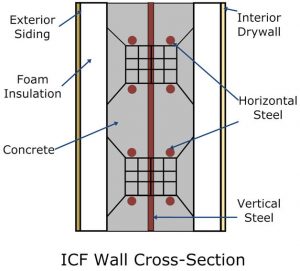
ICF blocks come in several sizes, although a common size for walls is 16 inches high by 4 feet long. The concrete core can also vary in width, though is typically 4-10 inches thick. Manufacturers also make corner blocks, typically reversible top-to-bottom so they can be used on the left or right side. The forms are versatile and can be used both for basement and above-grade walls (a concrete pump is needed to fill in tall walls). They can also be used for foundations, such as a frost-protected shallow foundation, or walls around a crawlspace.
ICF walls can be finished on the interior with drywall or a similar product. On the exterior, they can be finished with brick, stucco, vinyl or another siding. The interior and exterior finishes are attached to the flanges of the plastic ties.
Because they come in a variety of thicknesses and sizes, ICFs can be matched to a homeowner’s needs. Recycled materials are also available. The R-value depends on the thickness of the insulating foam board. Most ICFs are made of expanded polystyrene (EPS) foam, which is rated about R-4 per inch.
Of course, the total R-value of the wall can be increased by adding more foam to the exterior of the ICF wall. The strength of the wall depends on the thickness of the concrete and the amount of steel rebar. In areas with high winds and hurricanes, the structural strength can be increased by adding more rebar and a thicker concrete layer.
The concrete core also means the walls are fire-resistant; however, ICF walls need a thermal barrier on the interior, such as gypsum drywall, similar to a wood-framed wall.
One disadvantage of ICF walls is that they are more expensive than building a frame wall. They also allow for less on-site design changes because the forms are pre-ordered through a manufacturer. On the other hand, with their high strength, airtight envelope, and good sound attenuation, they are a good choice for some applications.
If you are interested in learning more about ICFs, visit the website of the Insulating Concrete Form Association, which provides training and information on codes, standards, and other frequently asked questions.