Why look at the Whole Wall R-Value of your Wall?
You might think your walls are R-20, or R-30, because of the amount of insulation you have in the wall cavity. But have you factored in your studs and windows? Today’s emphasis on energy efficiency means that many people define their walls by the R-value, yet you’re not getting a complete picture unless you’re looking at the “whole wall R-value.”
For instance, if you have 2×6 walls filled with fiberglass batt insulation (R-19), plus drywall and plywood, you probably consider your overall R-value to be R-21. But that only counts the insulated portion of your wall and ignores the weaker parts, such as windows, doors and structural framing, that provide primary paths for heat to escape. Just as water and electricity seek the path of least resistance, heat flows through the weakest thermal component of the wall assembly.
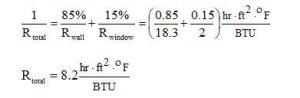
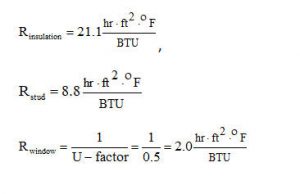
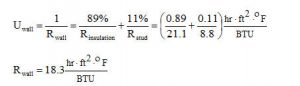
To see how much studs and windows affect the performance of your wall, CCHRC calculated the “whole wall R-value” for a hypothetical 2×6 house with 11 percent of the wall taken up by studs (24-inch on center framing) and 15 percent of the area taken up by double-pane windows. When you factor in the studs (R-8.8), the original R-21 wall is reduced to R-18.3. And it’s further diminished to R-8.2 when you factor in windows with a U-value of 0.5 (standard double-pane windows). In other words, your R-21 wall actually has a “whole wall R-value” of only 8.2–quite a big difference in energy performance!
How can this information help you improve the energy efficiency of your home? First, it gives an accurate picture of the overall thermal resistance of your wall. (Though there are many other components of a house, such as attic insulation, heating system, and ventilation system, that impact efficiency.) Second, it reveals how much the weak points can counteract stronger points in your wall.
And third, it illuminates retrofitting options, each with their ups and downs. Replacing windows, for example, may achieve a greater whole wall R-value, but it can be pricey. Adding exterior foam, on the other hand, can be a cheaper way to cut heat loss through the insulated wall and through the studs. But you must be careful to add the right amount of insulation, and possibly extra ventilation, to avoid creating moisture problems within the walls.
The best way to weigh these costs and benefits and make the most of your retrofit is to get a home energy audit. Why does this matter? Not only does the whole wall R-Value give you a more accurate picture of your thermal resistance, it also helps inform a retrofit decision. Does it make more sense to add extra wall insulation or upgrade your windows? Which will give you a better improvement in total wall R-value?
We tackled this question using the same hypothetical house mentioned above. Because the insulated wall makes up 75 percent of the whole wall, it would seem like a good place to focus on. Adding 2 inches of EPS foam to the outside improves the whole-wall R-value by 15 percent (it also increases the likelihood of interior moisture damage). However, upgrading the windows, which comprise just 15 percent of the wall, to triple panes improves the R-value by 59 percent. In other words, it does little good to add more wall insulation if most of the heat is leaving through your windows.
Of course, there are many other components in the building envelope that impact the energy efficiency of a home, such as space heating, ventilation, and hot water heating. Calculating your whole wall R-value simply reveals your true thermal resistance and points out where you could best reduce heat loss.
Want to calculate your Whole Wall R-Value? Here are the formulas:
The hypothetical home:
CALCULATING R-VALUE WITH STUDS
CALCULATING R-VALUE WITH WINDOWS